https://leafw-blog-pic.oss-cn-hangzhou.aliyuncs.com/avatar.jpg

Anthropic's Homegrown Source Control: Scion

https://leafw-blog-pic.oss-cn-hangzhou.aliyuncs.com/scion-cover.png

On October 13, 2026, Anthropic published an engineering blog post titled Redesigning source control at Anthropic. The official write-up says the company built its own source-control system, Scion, and fully migrated its monorepo off git in about five months. In the same window it also shipped a code-review surface called Antique, code search, a source-code permissions model, and tooling for landing large volumes of already-reviewed code. This piece focuses on Scion. The team behind Scion, Antique, and related systems is about seven people.

Self-Evolution Without Verification Writes the Wrong Lessons into the Harness

https://leafw-blog-pic.oss-cn-hangzhou.aliyuncs.com/verse-self-evolution-cover.png

If you have used coding agents like Claude Code or Codex for a while, you have probably done this: the agent makes a mistake, and you add a rule to AGENTS.md or CLAUDE.md along the lines of “don’t do xxx again.” Afterwards it feels like it probably won’t make that mistake next time, and to be fair, it does become less likely. But most of the time, I never paid attention to the other side effects that rule brought along.

First Impressions of DeepSeek Harness: Everything Being a Plugin Is Too Cool

DeepSeek Harness was released last Friday. Within a few hours, it was everywhere in AI communities in China and abroad.

I downloaded it right away and tried it. If you only look at the default interface, the first impression is honestly a bit rough. There are not many feature entry points. It does not even have a client yet. The interaction details are not as complete as Codex, Claude Code, or WorkBuddy. Those products have already been polished for a while. You can open them and start working, and many workflows have already been thought through for you. DeepSeek Harness is still in Developer Preview, and the official README directly says that breaking changes may happen.

What Math Is Hidden Behind Gojo Satoru's Infinity?

I read an interesting short math paper today. It came from a recent Oxford mathematics competition, titled Mathematics Behind Jujutsu Kaisen: Gojo Satoru’s Infinity. It does something fun: it treats Gojo Satoru’s Limitless technique in Jujutsu Kaisen as a mathematical object.

This kind of article can easily turn into a joke. This one does not. It does not stop at “anime settings are fun.” It keeps pushing Gojo’s technique into actual mathematical language. The real question it asks is:

An Interesting Framework: Performative UI

Today I saw a fun project on Hacker News: Performative UI.

Its self-description is just one simple sentence: an “AI-native React Components” library. But after clicking around for a few seconds, you realize every component feels familiar. It is not trying to be a serious, stable component library like shadcn/ui. It is directly targeting the highly homogenized AI startup website style.

In other words, it packages the kind of thing you often see when opening a new product site, where the AI smell almost spills out of the screen:

I Asked You, Not AI

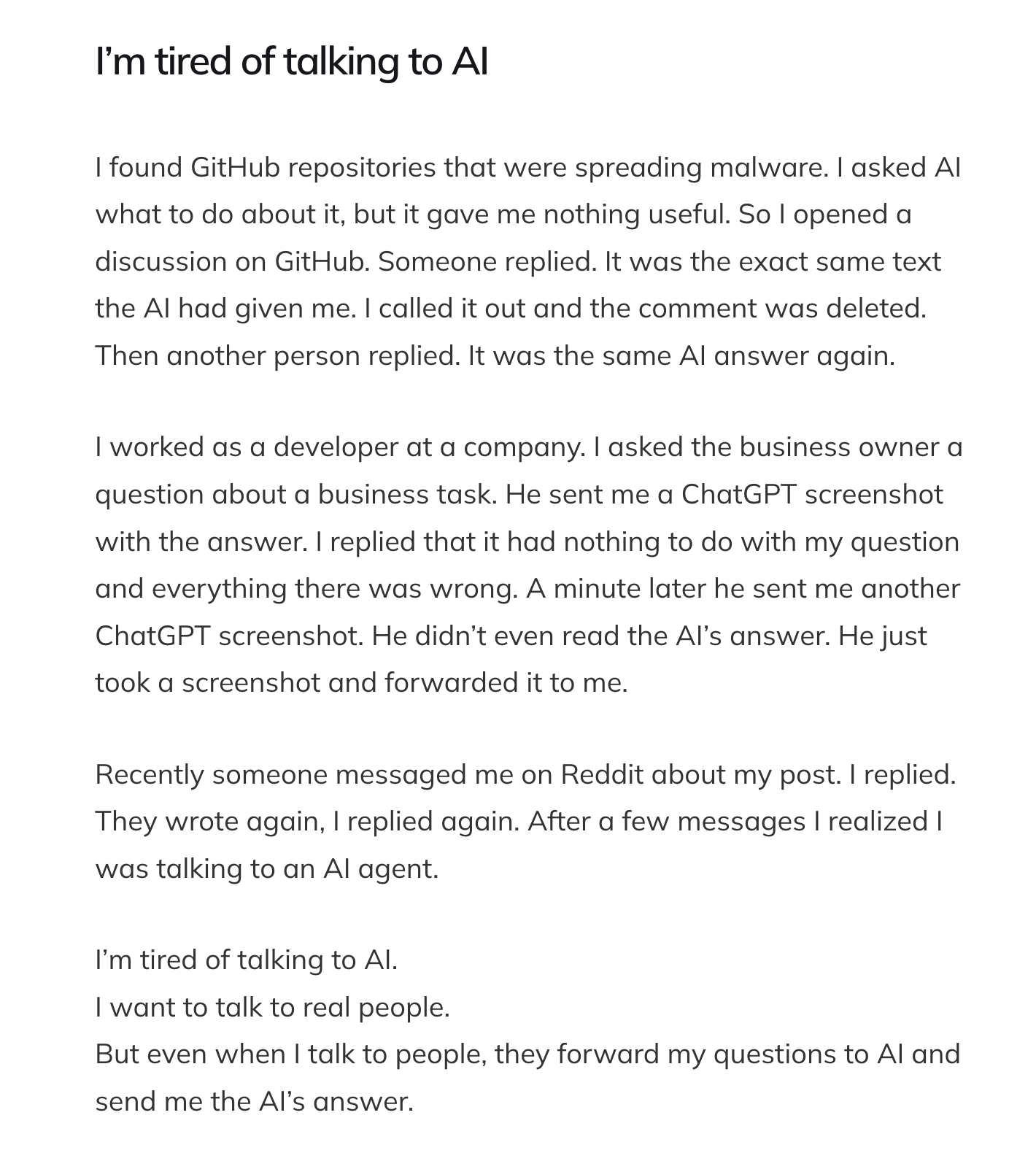
A few days ago, a Hacker News post became fairly popular. Its title was I’m tired of talking to AI. The original article is very short and takes about a minute to read, but the scene it describes hit me hard.

https://leafw-blog-pic.oss-cn-hangzhou.aliyuncs.com/posts/tired-of-talking-to-ai/ScreenShot_2026-06-02_200539_977.png

The author first says that he found some GitHub repositories spreading malware, so he asked AI what to do. AI gave him a useless answer. Later he opened a GitHub discussion, and someone replied with almost exactly the same content as the AI answer. After he pointed that out, the comment was deleted. Then another person came along and posted the same kind of AI answer again.