I Asked You, Not AI
A few days ago, a Hacker News post became fairly popular. Its title was I’m tired of talking to AI. The original article is very short and takes about a minute to read, but the scene it describes hit me hard.
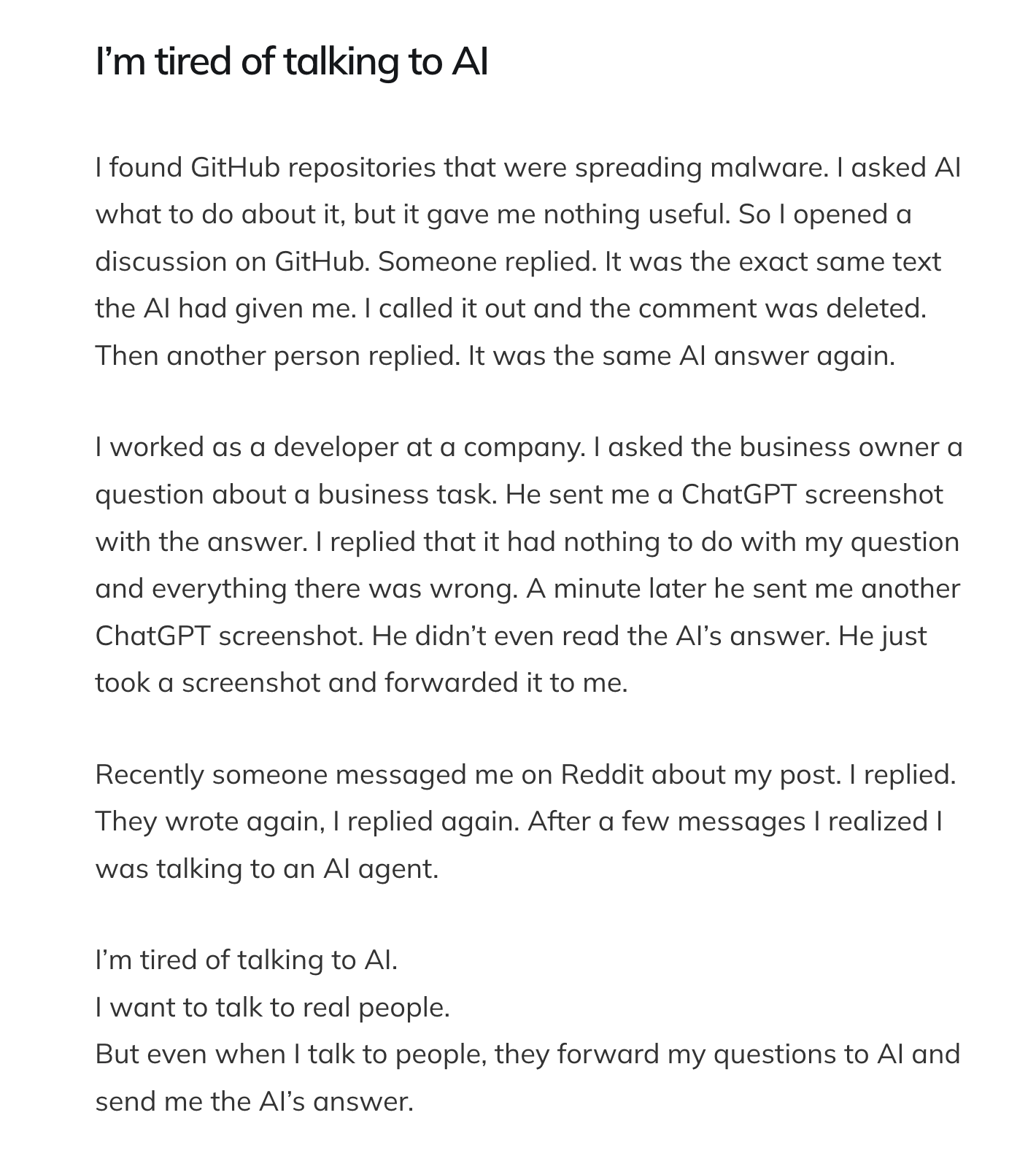
The author first says that he found some GitHub repositories spreading malware, so he asked AI what to do. AI gave him a useless answer. Later he opened a GitHub discussion, and someone replied with almost exactly the same content as the AI answer. After he pointed that out, the comment was deleted. Then another person came along and posted the same kind of AI answer again.
Another time, while doing development work at his company, he asked a business owner a business question. The other person sent him a ChatGPT screenshot. He said the answer had nothing to do with the question and was completely wrong. A minute later, the person sent another screenshot.
The most speechless part was that the other person did not seem to have read it at all.
Later, someone messaged him on Reddit. He replied seriously for several rounds, only to discover in the end that he had been talking to an AI agent.
So he said: I am tired. I do not want to talk to AI anymore. I want to talk to real people.
On the surface, this sounds anti-AI. But what I read was a more specific fatigue: I was clearly asking you, but you handed me off to a model.
Here, “you” refers to people who throw someone else’s question into AI and then forward the result unchanged. It does not refer to everyone who uses AI, and certainly not to every reader of this article.
I do not know whether you have encountered similar situations in life or work. I am encountering them more and more.
Using AI Is Not Shameful. Avoiding a Real Response Is.
I am a heavy AI user myself. Especially when writing code, I use Claude Code, Codex, various models, and many tools. In many cases, not using them would be unrealistic.
So I do not want to reduce this to “using AI means being insincere.” That is too crude and does not match reality. AI is indeed a powerful assistant for me, and there is no reason not to use it.
It is fine to let AI help organize your expression. If you have an idea in your head but say it messily, asking AI to turn it into a sendable email is reasonable. If you need to answer a technical question, asking AI to list several directions first and then judging which ones are reliable is also reasonable. Even asking AI to polish wording is reasonable. People sometimes get emotional; at least the model will not get emotional with you.
What makes me uncomfortable is another situation.
Someone asks a specific person a question, and that person copies it into AI, then pastes the AI output back unchanged. There is no judgment, no editing, no connection to context. The person has been reduced to a relay. Is that right?
At that point, the tool has crossed the boundary of assisting expression and has started appearing in place of the person.
When people ask a question, they often want more than a piece of text. They may want the other person’s judgment, their position, or a sign that the matter has actually been taken seriously.
When the other person replies with a ChatGPT screenshot, especially one that is obviously unread, unfiltered, and disconnected from context, it is hard to feel “efficient.” It is easier to feel: he does not want to talk to me. More seriously, I feel that he does not respect my question. His thought may be: AI can answer this easily, and you still need to ask me?
That is the part of the original article that resonated with me most. The author had already asked AI at the beginning. What disappointed him was that the real people who came later still gave him the same AI answer.
Asking a Question Already Contains Trust
Asking questions at work is actually subtle.
When a developer asks a business owner about business logic, they usually also want that person’s business judgment. They are saying: I do not understand this part, and I need the business owner to fill it in.
When a colleague asks another person for advice on a solution, they may not be asking for “best practices.” More likely, they are asking: given that person’s understanding of this project, this team, and this moment, how should we choose?
When someone tells another person about a problem, they may not be asking for step-by-step instructions. They may simply want to confirm: is this serious, did I miss something, and is the other person willing to look at it together?
These things cannot be treated as generic Q&A.
AI easily gives generic answers. It organizes questions completely, splits them into points, keeps a stable tone, and formats them nicely. But many real problems lack participation, not text.
Forwarding an AI answer directly damages trust for exactly this reason.
“The answer looks professional” does not build much trust. What helps more is a simple feeling: I know the other person really read my question, and I know they are willing to be responsible for what they said.
If someone always uses AI to reply instead of themselves, others will eventually wonder: am I communicating with this person, or am I providing prompts for them?
That sounds harsh, but I think it is accurate.
AI Can Package Perfuntory Replies Beautifully
One of the most troublesome things about AI is that it creates the illusion that “I have handled this.”
A person copies a colleague’s question into a model, gets an answer, and forwards it. The whole process takes less than a minute. They may even feel they responded quickly, at least not ignoring the message.
But mainly, they are just carrying text.
The sender has not judged whether the answer is correct, checked whether it matches the current context, or added their own position. They have only handed someone a smoother piece of writing.
In the past, if someone was perfunctory, they might delay replying or say, “I’ll take a look.” That kind of perfunctory response was ugly and easy to identify. Now it is different. AI can package perfunctory behavior into something structured, polite, and seemingly serious.
That is more dangerous than “I don’t know.”
If someone says “I don’t know,” at least it is true. If someone does not know but sends a paragraph that looks like it knows everything, there will be costs later.
In technical and business collaboration, those costs are especially visible. Developers implement based on a wrong business explanation. QA verifies based on a wrong understanding. Product thinks the other side has confirmed. Finally, the issue explodes in production, and when everyone looks back at the chat logs, it seems every step had a reply.
The problem is that nobody actually judged anything.
AI will not be responsible. The person who pressed send is responsible.
The More You Use It, the Less You Should Trust It Blindly
Interestingly, people who truly use AI deeply usually do not trust AI answers that easily.
The more you use it, the more you know where it is strong and where it is weak.
With the development of agent capabilities, AI can now complete many tasks that previously seemed complex, including writing emails, research reports, and code. It can save a lot of effort and give you a starting point when you are stuck.
But the fatal part is that it is also very good at pretending to understand. It states uncertainty with confidence, fills missing context with imagined context, and treats “looks reasonable” as “factually correct.”
When facing a specific project or business context, it often gives you a surface-level suggestion in the most direct, straightforward, objective, real, brief, understandable, and non-mysterious way possible. And the suggestion is useless.
When I use AI to write code, the most important step is always acceptance.
Can it compile? Do the tests pass? Did the interface contract change? Did permission boundaries break? Are exception cases covered? Does it match the existing code style? Humans have to judge all of this.
Communication is the same.
AI can help draft a reply. Before sending it, you should at least pause:
- Is this really the question the other person asked?
- Is there any part where I must state my own position?
- Are there facts in this reply that I cannot personally confirm?
- If the other person follows this reply and something goes wrong, who is responsible?
If you have not thought through these questions, do not rush to send it.
AI is not universal to that degree. It is like a fast assistant that is good at organizing language but lacks situational awareness. You can let it help with work, but human judgment still has to come from you.
“Let AI Solve It” Is Often Empty Talk
These days, under many problems, it is easy to see one sentence: just let AI do it.
Write documentation? Let AI write it. Make a plan? Let AI produce it. Write code? Let AI generate it. Communication is hard? Let AI help reply.
Sometimes this is advice. Sometimes it is just another way to be perfunctory.
Because “let AI do it” only chooses the tool. A lot of harder things remain: what is the input, what are the constraints, what is the acceptance standard, who judges whether the result is good, and who fixes it when it is wrong?
When many people say “let AI solve it,” they are actually skipping the hardest part.
Especially when the problem itself has not been explained clearly, throwing it directly to AI usually produces prettier nonsense. If requirements are unclear, AI writes a proposal template. If the root cause of a technical issue has not been located, AI lists a dozen possible causes. If nobody can explain the business process, AI summarizes familiar empty phrases everyone has heard before.
These things can be useful as a starting point.
But the problem cannot stop at the starting point.
Teams Need New Etiquette
I think many teams have not yet formed etiquette around AI use.
In the past, people at least knew some boundaries. If someone seriously asked you a question, you could not casually copy a search result to them. If someone asked you to make a judgment, you could not just throw them a link. If someone needed you to confirm a business rule, you could not answer, “that’s what the internet says.”
After AI appeared, these boundaries became blurry because AI output looks too much like a complete reply. It is more like an answer than a search result, more like thinking than a template, and more like your own words than an external link.
Maybe we need to pick up some very basic common sense again.
Read AI content before forwarding it.
If you use AI to organize something, say so clearly: “I asked AI to help me structure a version. After reading it, I think these two points are usable.”
In scenarios involving business judgment, technical decisions, customer commitments, legal risk, medical care, finance, and similar areas, do not treat AI output as the final answer.
If someone asks for a particular person’s opinion, that person should give their own opinion. AI can help organize the language, but it cannot replace judgment.
These rules sound like nonsense. But the biggest problem now is that many people are losing even nonsense-level common sense in front of AI.
I Want to Collaborate With Real People
There was a lot of resonance under that HN post, probably because people are starting to feel a new kind of fatigue: we are processing more and more hollow communication.
I do not think the old internet or old workplace was pure. Humans have always been perfunctory, used stock phrases, avoided problems, and used templates to deal with others. AI makes these behaviors cheaper and more presentable.
In the past, when someone was perfunctory with you, you could probably feel it. Now they can send a structured, polite, clearly organized reply. After reading it, you realize there is no judgment in it that truly belongs to them.
In the past, if someone did not know the answer to your question, they might think through possible directions or honestly say they did not know. Now they can reply with an elegant, seemingly workable plan, and then look down on you for not asking AI yourself.
As a developer who uses AI every day, I know that the more heavily you use it, the more clearly you must draw boundaries.
AI can help me write the first version of code. I am responsible for the final code.
AI can help me organize material. I am responsible for the final judgment.
AI can help me polish a reply. I am still the person who says it.
If I forward AI’s answer unchanged to someone else, I have not become more efficient. I have packaged the understanding, judgment, and response that should have come from me into a decent-looking paragraph.
That is not collaboration. It is pushing someone else toward a model.
Finally
I understand the sentence I’m tired of talking to AI.
The author was not opposing the development of AI. What he wanted to express was: I asked you. I did not ask whether you could invoke AI for me once.
This may become an important communication baseline in the future.
AI is well suited to repetitive work. It is not well suited to maintaining trust between people on our behalf.
When someone comes to you, they often want to confirm one thing: there is really a person on the other side listening and thinking.