The Collective Boos at AI During U.S. Commencement Ceremonies
At some U.S. university commencement ceremonies last week, the audience started booing as soon as speakers praised AI. The speakers may have been surprised, but I think many ordinary workers and students like us can understand the reaction.
Commencement is already a delicate occasion. In the audience are young people about to enter the job market. Many may still carry tuition debt, have just sent out resumes, and may not have stable internships or full-time offers. On stage, the guests are often already successful. They begin, in a relaxed tone, to tell students: AI is the future, and you should embrace change.
That message is fine at a technology conference. At a commencement ceremony, it feels different. Especially when the people saying it come from Google, real estate companies, or record companies close to commercial interests, it is hard for the audience to hear it only as kind advice. Students may hear another meaning: jobs will shrink, requirements will rise, the rules have changed, and you had better adapt quickly.
If I were sitting below the stage, I probably would not feel great either.
What Happened
AP reported that former Google CEO Eric Schmidt was repeatedly interrupted by about 10,000 graduates while speaking about AI at the University of Arizona commencement. When he said AI would touch careers, classrooms, hospitals, laboratories, and relationships, the boos grew louder. He later paused to reassure students, saying their fears were valid because many worried the future had already been written, machines were coming, and jobs were evaporating.
NBC’s video also grouped several ceremonies together. In addition to Schmidt, speakers at the University of Central Florida and Middle Tennessee State University were also booed when talking about AI.
Schmidt certainly knows what students are worried about. He also knows this kind of fear cannot be suppressed with a simple "AI will create opportunities." The problem is that he still returned to the familiar line: AI will shape the world, and you should help guide it.
That sentence is not wrong. It may even be correct.
But students may not want to hear correct words. They may want an honest one: the job market they are about to enter will indeed be more awkward than it was a few years ago.
Something similar happened at the University of Central Florida. Real estate executive Gloria Caulfield called AI the next industrial revolution, and the audience immediately booed. At Middle Tennessee State University, Big Machine Records CEO Scott Borchetta said AI was rewriting production workflows. After being booed, he said, essentially, accept reality. It is a tool. Make it work for you.
I agree with the tool argument. But "accept reality" sounds harsh when said from the stage, especially when that reality was not made by the people sitting below.
AI Layoffs Are No Longer Just a Prediction
First, acknowledge reality.
AI’s impact on employment has already started. Challenger, Gray & Christmas’s April 2026 job-cut report showed that among layoffs announced by U.S. companies in April, AI was the top reason for the second consecutive month, affecting 21,490 jobs, or 26% of all cuts that month. In the first four months of 2026, AI was listed as the reason for 49,135 planned cuts, about 16% of total announced cuts during the period.
This number cannot be directly translated into "all these people were replaced by AI." Companies have room to package the reasons for layoffs. But it at least shows one thing: AI has become a convenient reason for companies to explain organizational adjustments.
Some companies are more direct.
Amazon CEO Andy Jassy said in a 2025 employee memo that as the company deployed more generative AI and agents, it would need fewer people doing some work done today, while also needing more people for new work. He said it was hard to predict the net impact precisely, but over the next few years the company’s corporate headcount would decline because of efficiency gains.
Shopify CEO Tobi Lutke turned this into something closer to a management rule. In a 2025 internal memo, he required teams to prove why they could not achieve their goals with AI before asking for more headcount and resources. Previously, when workload increased, teams naturally thought about hiring. Now the default assumption has changed: first ask whether AI can carry part of it.
Klarna is also a typical case. It once said its AI customer-service assistant did work equivalent to 700 full-time agents. Later, its CEO admitted the company had reduced headcount significantly through hiring freezes and natural attrition. By 2025, Klarna began emphasizing human customer service again because pure cost reduction affected service quality.
Salesforce’s Marc Benioff has said similar things. In 2025, when talking about the support team, he said Salesforce reduced the team from about 9,000 to 5,000 because AI agents handled a large number of conversations, so fewer people were needed.
Anthropic CEO Dario Amodei was more aggressive. In a 2025 Axios interview, he warned that AI could eliminate half of entry-level white-collar jobs within one to five years and push unemployment to 10%-20%.
These statements should not be waved away lightly. Customer service, translation, localization, content generation, junior operations, some sales support, and parts of finance and HR back-office workflows are indeed being reshaped by AI. The more standardized the work, the more stable the context, and the clearer the acceptance criteria, the greater the pressure.
Saying there is no impact at all is self-deception.
The "Job Apocalypse" Also Sounds Too Extreme
On the other hand, I also do not fully believe the claim that AI will immediately destroy huge numbers of human jobs.
As of April 2026, the U.S. unemployment rate was 4.3%, and the BLS reported that nonfarm payroll employment still increased by 115,000 that month. This does not prove everyone can easily find a job, and it does not erase pressure on graduates and entry-level roles. It only shows that, at the macro level, the employment collapse some people predict has not appeared yet.
The software industry is even more worth watching.
If we had to pick a field most likely to be affected by AI coding tools, software development would be near the top. Claude Code, Codex, and various coding agents are pushing the act of writing code toward automation almost every day.
The BLS 2024-2034 outlook for software developers, QA analysts, and testers is still 15% growth, far above the average for all occupations. The BLS also says that expanding AI, IoT, robotics, and automation applications will continue to drive demand for software developers, software quality analysts, and testers.
Programmers do not have immunity, of course.
This only reminds us that there is a large amount of engineering reality between AI being able to write code and programmers losing their value.
Jensen Huang Also Talked About AI at Commencements
There is an interesting contrast here.
Jensen Huang has also spoken about AI at university commencement ceremonies. In May 2026, he spoke at Carnegie Mellon University. Earlier, he had given similar talks at Caltech’s 2024 commencement and National Taiwan University’s 2023 commencement.

At least based on public reports, he did not encounter the kind of full-audience booing Schmidt did. CMU’s official news story framed the talk as "shape what comes next," and NVIDIA’s own blog emphasized that the graduates’ careers were beginning at the start of the AI revolution. Axios was more direct: Jensen Huang told college graduates to run toward AI.
Why such different reactions to the same topic?
First, the school context is different. CMU is already a center for AI, robotics, and computer science. Huang also deliberately connected AI history back to CMU, mentioning Logic Theorist and the Robotics Institute. For CMU graduates, AI is not just an external force. It is part of their professional identity. If you tell a group of computer science, robotics, and engineering-heavy graduates that AI will create new industries, they can more easily place themselves inside that story.
Second, Huang’s emphasis was on building. Axios reported that he described AI infrastructure as an opportunity for reindustrialization, saying it would require plumbers, electricians, steelworkers, chip factories, data centers, and advanced manufacturing. At least this gives a concrete picture: where jobs may appear, what kind of work is needed, and why people are still needed.
Speeches like Schmidt’s can sound more like abstract instruction. AI will change the world. You must guide it. You must accept it. Every sentence may be right, but to graduates, it can still feel empty.
Third, Huang stands on a supply chain that is still expanding. NVIDIA certainly has a strong commercial motive, and its praise of AI cannot be completely neutral. But from a graduate’s perspective, GPUs, data centers, robotics, chip manufacturing, and related areas are still hiring and expanding, and can offer paths for engineering students. By contrast, when a real estate executive, a record-company CEO, or a former Google CEO talks about AI, students are more likely to think of cost cutting, replacement, and job shrinkage.
This is why I do not want to simply interpret the boos as "students hate AI." They may hate optimism that does not provide a concrete path.
If you tell graduates that AI is powerful and they must adapt, resentment comes easily.
If you tell them what infrastructure AI will require, what engineering problems it will create, what new jobs may appear, and what concrete skills will matter, then even if they remain anxious, the words are at least easier to hear.
The Boundary of Vibe Coding
I have always disliked one claim: in the future, people who cannot code will still be able to make software freely, so code has no value and programmers have no value.
This view treats software development too lightly.
Getting a program to run locally is only a small part of software engineering. The hard parts usually come later: what the requirements actually are, where the edge cases are, how to design the data model, whether the architecture can scale, how permissions are constrained, how errors recover, how logs help locate problems, where bottlenecks appear when users grow, how deployments roll out, how monitoring is configured, how dependencies are upgraded, how security vulnerabilities are handled, and who takes responsibility when incidents happen.
AI is very good at turning a vague idea into a first version of code.
The first version is still far from production-ready.
Especially in software systems with multi-person collaboration, long-term maintenance, and continuous iteration, the value is not only in the code itself. More important is a whole set of engineering judgment: where things should be simple, where they must be strict, which requirements can be cut first, which design debts will be fatal later, when to trust AI, and when to read source code, documentation, tests, and reproduce problems yourself.
Vibe coding lowers the barrier to writing programs. That is good. More people can turn ideas into working things, which is exactly what technological progress should do.
After the barrier falls, professional ability does not automatically disappear. Cameras let more people take photos, but photographers still exist. Excel let more people work with spreadsheets, but finance professionals still exist. Low-code tools let more people build workflows, but people who understand system design remain valuable.
What usually gets compressed is work with low complexity, low responsibility boundaries, and low quality requirements.
When that work shrinks, human ability requirements move upward. Programmers may spend less time typing boilerplate and more time judging, decomposing, verifying, governing, and taking responsibility.
This is less dramatic than "programmers are finished," but it is probably closer to the real world.
Why Entrepreneurs Like Talking About Replacement
Andrew Ng recently posted about why there will not be an AI jobs apocalypse, and one part is worth thinking about.
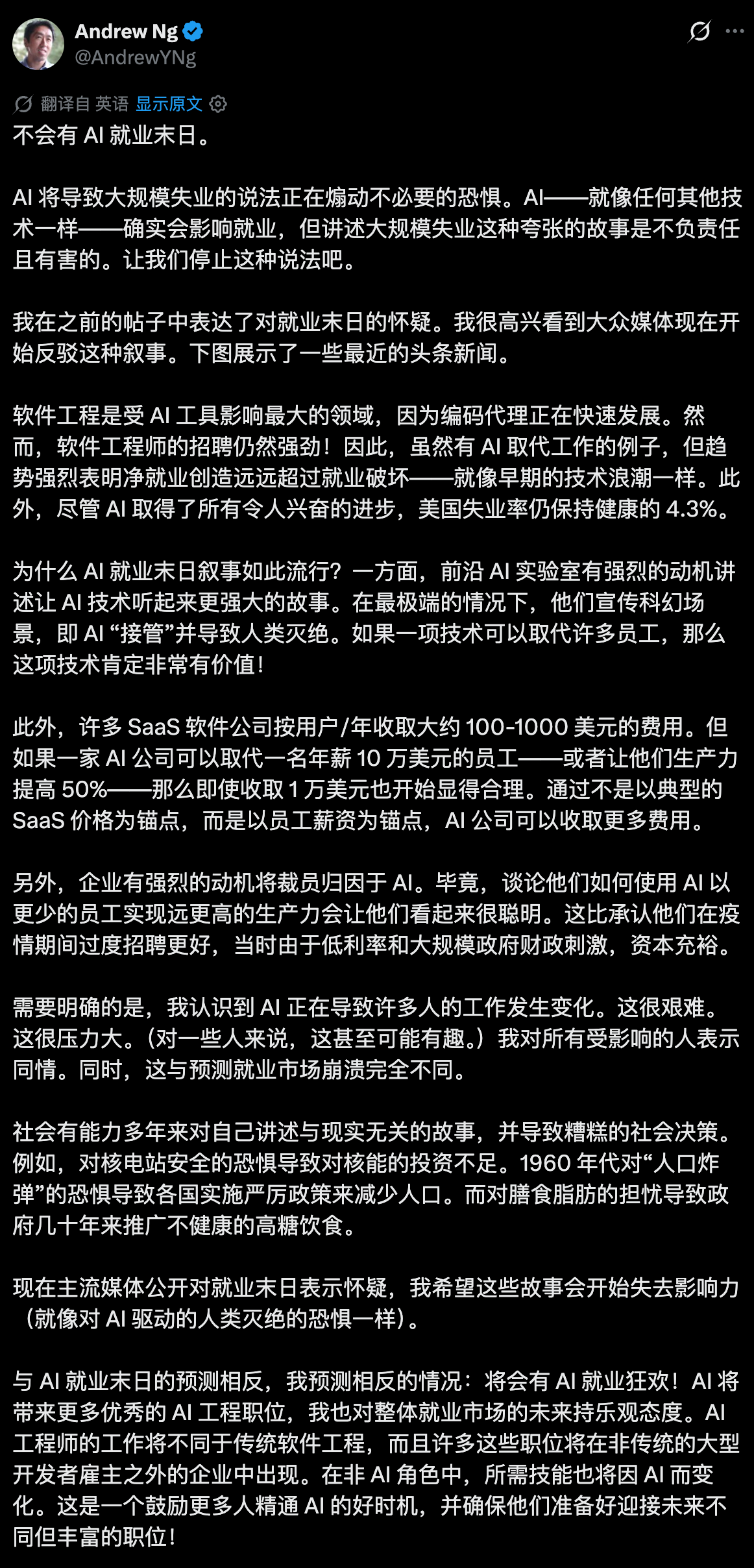
He said AI companies have an incentive to describe their technology as extremely powerful. If a technology can replace an employee making $100,000 per year, then charging $10,000 looks cheap. If people think of it like ordinary SaaS, they may only be willing to pay hundreds or a few thousand dollars per year.
This is a realistic perspective.
Whether AI can replace people is a technical question. It is also a pricing question, a financing question, and a sales question.
The enterprise side is similar. Saying "we improved efficiency with AI, so we do not need as many people" sounds more respectable than saying "we hired too much during the pandemic," "business growth did not match valuation," "margin pressure is high," or "management made the wrong call."
I do not want to call all entrepreneurs liars. Some truly believe AI will replace many jobs in the short term, and some companies have genuinely found cost advantages in specific workflows.
But when a company is selling AI products, raising capital, telling a growth story, or explaining margins to capital markets, its statements about "AI replacing people" cannot be read only as technical judgment.
There is product marketing, valuation storytelling, and layoff PR inside it.
More Specific Than "Embrace AI"
I am not against companies requiring employees to use AI.
In fact, people who do not learn AI tools will increasingly be at a disadvantage. Gallup workplace data also shows that by February 2026, half of U.S. employees used AI at least occasionally at work, with 28% using it several times per week or more. AI has entered daily workflows. It is no longer a toy for a small group of technology enthusiasts.
Interestingly, rising usage has not brought the same level of excitement. Another Gallup survey of Gen Z found that among Americans aged 14-29 in 2026, excitement about AI fell from 36% the previous year to 22%, anger rose to 31%, and anxiety remained at 42%.
That matches the boos at commencement ceremonies. Many people are using AI while also not believing the easy, cheerful AI narrative.
I would rather look at specific workflows.
For example, MediaStorm previously shared how they used AI in company workflows. I think those kinds of cases are more useful: no empty slogans, no treating the model as an all-purpose employee. First break down the workflow, find places where AI can stably improve human efficiency, then embed it gradually.
Software development follows the same logic.
AI can help me generate scaffolding, explain unfamiliar code, add tests, write SQL, organize logs, perform a first round of code review, and turn vague requirements into task lists. These are all useful. I use AI heavily myself.
But the final judgment still has to be human.
What is the business goal? Where are the system boundaries? How should interface contracts be defined? How is data consistency guaranteed? How are exceptional cases handled? How are performance metrics observed? How are production incidents rolled back? These questions cannot be brushed aside with "it seems to run."
Someone who has truly used AI coding tools heavily should feel both their efficiency and their boundaries.
If you only see efficiency, it is easy to become overexcited. If you only stare at the boundaries, you may miss the tool dividend. A practical attitude is to admit it is useful and then put it in the right place.
Ordinary People Should Watch Out for Two Illusions
The first illusion is underestimating change.
Thinking AI is just a dressed-up search engine and the hype will pass in a few years is dangerous, because many jobs’ workflows have already changed.
The second illusion is overestimating change.
Thinking AI will immediately replace everything and that learning anything is useless is also dangerous, because it makes people give up their professional accumulation too early.
I now prefer to analyze tasks rather than jobs. Talking directly about jobs is too coarse-grained.
Which tasks will be automated? Formatting, summarization, first drafts, batch generation, information extraction, simple customer service, and templated code are already obvious.
Which jobs will be reorganized? In one role, maybe 30% of tasks are eaten by AI, while the remaining 70% become heavier and more demanding.
Which abilities become more valuable? Requirement judgment, system design, product understanding, domain knowledge, taste, communication, responsibility, complex problem decomposition, and quality control.
For programmers, one form of laziness is especially dangerous: treating the ability to generate code with AI as proof that your engineering ability has improved. That is far from enough.
You can use AI to write more code, but you must also understand engineering more deeply. Otherwise, you only turn yourself from someone who writes bugs by hand into someone who cannot finish reviewing AI-generated bugs.
Finally
I understand the graduates’ boos.
They were booing a light, floating sense of certainty. People on stage say AI is an opportunity. People below see fewer entry-level roles, changing hiring requirements, tuition debt, and a more uncertain future.
AI will affect employment. Some jobs will disappear, some will shrink, and many will be reorganized. There is no need to beautify that.
But there is also no need to blindly believe in an AI jobs apocalypse. Sometimes it is a technical prediction, sometimes product marketing, sometimes a financing story, and sometimes a pretty reason companies give for layoffs.
I would rather see AI as a repricing.
Low-quality repetitive labor will be compressed. People who only execute without understanding context will be in greater danger. People who can put AI into real workflows, understand business, engineering, and quality, and take responsibility for outcomes will become more important.
So use the tools, and use them heavily.
After using them, we should see more clearly what they can do, what they cannot do, who is exaggerating them, who is using them to save money, who is using them to sell courses, who is using them to raise capital, and who is using them to justify layoffs.
The reason for those boos is not hard to understand. The young people in the audience listened and felt that the speakers’ words were too easy, and did not match the reality they were about to face.
References
- AP: AI pep talks at college commencements prompt boos from graduates
- NBC News: Multiple commencement speakers booed for AI comments during graduation speeches
- Challenger, Gray & Christmas: April 2026 Job Cut Report
- BLS: The Employment Situation, April 2026
- BLS: Software Developers, Quality Assurance Analysts, and Testers
- TechCrunch: Amazon expects to reduce corporate jobs due to AI
- TechCrunch: Shopify CEO tells teams to consider using AI before growing headcount
- CNBC: Klarna CEO says AI helped company shrink workforce by 40%
- CNBC: Salesforce CEO confirms 4,000 support role cuts with AI
- Axios: Business pushes replacing people with AI, but is AI ready?
- Carnegie Mellon University: NVIDIA Founder, CEO Jensen Huang to Carnegie Mellon University Graduates: Shape What Comes Next
- NVIDIA Blog: Your Career Starts at the Beginning of the AI Revolution
- Axios: Jensen Huang to college grads: Run. Don’t walk toward AI
- Caltech: Caltech Honors Graduates at 130th Commencement Ceremony
- National Taiwan University: NTU Commencement 2023
- Gallup: Rising AI Adoption Spurs Workforce Changes
- Gallup: Gen Z’s AI Adoption Steady, but Skepticism Climbs
- Andrew Ng-X