Anthropic Is Going Public: What the S-1 Reveals About Its Books

On October 26, Anthropic filed its S-1 registration statement with the U.S. Securities and Exchange Commission (SEC). The S-1 is the registration document a U.S. company must file before its initial public offering, covering its business, financials, risks, and ownership structure. This filing lays out Anthropic’s revenue, losses, compute spending, and equity arrangements, and Claude Code gets a dedicated spot in it as well.
This post revolves around two questions: with revenue growing this fast, can it cover the compute bills Anthropic has already signed; and once the company is public, who decides where it goes.
Except for figures I note as my own calculations, and the $63 billion from Broadcom’s press release, all numbers here come from the S-1, with periods and bases noted. Data for the first half of 2026 and for individual quarters are unaudited.
The Basics of the Listing
The S-1 cover states that Anthropic, PBC is applying to list its Class A common stock on the Nasdaq Global Select Market under the ticker ANT. Goldman Sachs and Morgan Stanley are the representatives of the underwriters. The price range, number of shares offered, and amount to be raised have not yet been disclosed.
The company was incorporated in Delaware in January 2021 and has been a PBC from the start. A PBC is a public benefit corporation: the law requires its board to balance, beyond stockholders’ financial interests, the interests of those materially affected by the company’s conduct and the public benefit purpose stated in its charter. The purpose written into Anthropic’s charter is “the responsible development and maintenance of advanced AI for the long-term benefit of humanity.”
Where the Revenue Comes From
Annual and Quarterly Revenue
Start with the totals. Revenue reported in the S-1 (in millions of USD):
| Period | Revenue | YoY |
|---|---|---|
| 2023 | 41 | — |
| 2024 | 386 | +841% |
| 2025 | 4,585 | +1,088% |
| H1 2025 | 1,163 | — |
| H1 2026 | 16,286 | +1,300% |
By quarter: Q1 2025 was $376 million, followed by $787 million, $1.38 billion, and $2.04 billion; Q1 2026 was $4.73 billion and Q2 $11.56 billion. Year over year for Q2 alone, revenue grew 1,368%, while compute and infrastructure expenses grew 300% over the same period. Q3 revenue and annualized revenue as of October 31 have not yet been disclosed.
Usage-Based vs. Subscription Revenue
The S-1 splits revenue into two types: usage-based and subscription. Usage-based revenue is priced per token, with prices varying by model; Anthropic calls this “paying for intelligence.” Subscriptions are for enterprise and individual users (e.g., Claude Pro, Max), generally prepaid monthly or annually, with usage caps.
| Period | Usage-based | Subscription | Usage-based share |
|---|---|---|---|
| 2024 | $288M | $98M | 75% |
| 2025 | $3,796M | $789M | 83% |
| H1 2026 | $13,064M | $3,222M | 80% |
More and more enterprises are signing non-cancelable one-year or multi-year contracts, trading minimum spend commitments for fixed rate cards, which still mainly generate usage-based revenue. As of June 30, 2026, remaining performance obligations (contracted revenue not yet recognized) stood at $10.8 billion, about 75% of which is expected to be recognized within the next 12 months.
Customer Count and Concentration
The S-1 doesn’t define “enterprise customers” separately. It measures enterprise adoption by “customers contributing at least $100,000 in revenue over the trailing twelve months”:
- These customers grew from about 20 at the end of 2023, to about 200 at the end of 2024, about 1,500 at the end of 2025, and more than 11,900 as of September 30, 2026;
- Their share of revenue was 90%, 57%, and 76% in 2023, 2024, and 2025 respectively, and about 74% in H1 2026 (when there were more than 6,000 such customers);
- As of September 30, 2026, more than 1,900 customers contributed over $1 million annually, and about 250 contributed over $10 million;
- For the twelve months ended September 30, the remaining revenue came from roughly 40 million customers each contributing less than $100,000.
On concentration, the S-1 says no single customer exceeded 10% of revenue in the first nine months of 2026, and the top five customers together accounted for about 25%. However, the notes to the financial statements show one customer at 11% in H1 2026, and two customers at 12% each in 2025. In Q3 2026, customers outside the top five contributed about 79% of revenue, versus about 64% in Q1 2026.
Net revenue retention was about 900% (as of September 30, 2026). That is, customers who had revenue in the same quarter a year earlier (excluding Pro and Max subscribers) spent about 9 times as much in the most recent quarter as they did a year ago.
Sales Channels and Geography
Customers can buy directly from Anthropic or through the AWS, Google Cloud, and Azure marketplaces. The share of revenue transacted through cloud marketplaces was about 11% in 2023, 32% in 2024, 47% in 2025, and 48% in H1 2026; marketplace-related receivables made up 58% of all accounts receivable (as of June 30, 2026).
Because Anthropic contracts directly with customers and sets its own prices, it recognizes revenue on a gross basis, and the fees paid to cloud providers are recorded under “sales, marketing, and partnerships” expenses. That line was $3.17 billion in H1 2026; of the $3 billion year-over-year increase, $2.7 billion was channel fees.
By customer billing address, H1 2026 revenue was $11.76 billion from the U.S. and $4.52 billion international, putting international at about 28% (my calculation from those two numbers).
Factors Affecting Revenue Quality
First, the S-1 estimates that about 5% to 7% of revenue in the first nine months of 2026 came from customers who violated the usage policy or commercial terms; this revenue was recognized before they were banned. Draw your own conclusions. The company says it strengthened detection and enforcement in August and September and expects the share to decline; the impact on growth is still uncertain.
Second, revenue is highly dependent on new models: more than 80% of Q3 revenue came from model versions released within the prior six months.
In addition, revenue is seasonal: in the two weeks ended January 2, 2026, total customer spend fell about 20% compared with the prior two weeks.
Where the Losses Come From
The Gap Between Net Loss and Operating Loss
The S-1 reports a net loss of $41.97 billion for 2025 and $80.75 billion for H1 2026. At the operating level, the numbers are much smaller (in millions of USD):
| Item | 2024 | 2025 | H1 2025 | H1 2026 |
|---|---|---|---|---|
| Operating loss | -2,980 | -8,060 | -2,135 | -693 |
| Change in fair value of convertible notes, etc. | -5,434 | -34,308 | -10,942 | -72,388 |
| Interest income | 106 | 431 | 115 | 1,111 |
| Other income (expense), net | — | -8 | — | -8,757 |
| Net loss | -8,309 | -41,965 | -12,969 | -80,748 |
Income taxes are not shown in the table.
Convertible notes are a financing instrument where money comes in first as a loan and later converts into stock at an agreed price. Anthropic elected fair value accounting, meaning at the end of each period it calculates what the notes are worth at the latest valuation: when the valuation rises, the shares the notes convert into are worth more, the liability grows, and the difference is booked as an expense. The S-1 states that the largest change came in Q2 2026, corresponding to the valuation step-up in the Series H round. In the cash flow statement, this expense is added back in full as a non-cash item. It costs no cash; the cost shows up at conversion: holders convert at the agreed price, and the higher the valuation, the more valuable the shares they receive. The S-1’s risk factors note that conversion will dilute existing stockholders.
In H1 2026, “other income (expense), net” also included about $8.8 billion of expense. The largest item in the notes is the initial recognition and fair value change of note purchase agreements, about $9.4 billion. Note purchase agreements are financing agreements Anthropic signed with Google, Amazon, and others, under which the counterparty agrees to buy notes or preferred stock at a fixed price in the future. These agreements are remeasured at market each period, with changes recorded in other income (expense); they are likewise added back as non-cash items in the cash flow statement. The two items together come to about $81.1 billion, more than the $80.75 billion net loss; the $690 million operating loss was offset by $1.11 billion of interest income. As of June 30, the accumulated deficit was $132.9 billion, of which $113.2 billion relates to fair value changes in notes and derivative liabilities.
Operating Profit and Cash Flow
The operating loss narrowed from $2.14 billion in H1 2025 to $690 million in H1 2026, and Q2 alone posted an operating profit of $974 million, an 8% margin. The company also provides an “adjusted operating profit” that excludes stock-based compensation, non-cash charitable contributions, and the $1.5 billion settlement of the copyright class action brought by Bartz and others. Adjusted operating profit for H1 2026 was $1.62 billion, a 10% margin; Q2 alone was $2.24 billion, a 19% margin. For full-year 2025, the adjusted operating loss was $4.85 billion.
On cash flow, H1 2026 saw net operating cash inflow of $3.9 billion, versus a net outflow of $1.5 billion in the same period of 2025. As of June 30, cash and cash equivalents were $112.4 billion, short-term investments $19.3 billion, and cumulative financing raised $141.1 billion.
There’s also an expense that will land all at once at the IPO. As of June 30, unrecognized expense for restricted stock units was about $26.6 billion, of which $2.9 billion corresponds to the portion whose service period has been fully or partially satisfied. These RSUs have the effectiveness of the registration statement as a performance condition, and the S-1 states that expenses will rise significantly in the quarter of the IPO; the exact amount has not yet been disclosed.
Compute Spending and Long-Term Contracts
How Compute Costs Are Accounted For
In 2025, Anthropic changed how it presents its income statement: instead of cost of revenue and gross profit, it now presents expenses by nature, with prior periods recast on the new basis. The largest line is “compute and infrastructure,” which includes cloud compute fees, hosting and lease costs, and power, and from 2026 also lease amortization and server depreciation, covering research, model development, serving customers, and internal use. The S-1’s explanation is that compute is scheduled as a single pool and planned in aggregate.
This expense as a share of revenue was 1,056% in 2023, 653% in 2024, 160% in 2025, and 55% in H1 2026. Quarterly, it fell from 251% in Q1 2025 to 48% in Q2 2026.

The chart’s data comes from the S-1’s quarterly income statements. In all four quarters of 2025, the orange line sits above the blue bars; from Q1 2026, revenue pulls ahead, and in Q2 revenue was $11.56 billion against $5.56 billion in compute expenses. The S-1’s explanation is that compute is typically contracted 12 to 18 months in advance and billed only after delivery, so near-term expenses are largely fixed, and revenue growth outpaced the costs already signed.
The notes to the financial statements also break down expenses by function. Cost of revenue (almost entirely the compute used to serve customers) was $2.77 billion in 2025 and $2.38 billion in H1 2026; R&D (mainly compute for model development, research, and internal use, plus R&D personnel costs) was $6.34 billion in 2025 and $9.74 billion in H1 2026. On this basis, cost of revenue was about 14.6% of revenue in H1 2026 and about 60.5% in 2025. These two ratios are my own calculations from the notes; the S-1 itself does not report a gross margin.
The S-1 also flags the opposite scenario: when large amounts of new compute come online, expenses are recognized ahead of revenue and margins may be squeezed; when demand exceeds long-term contracts, the company has to buy higher-priced short-term compute, and it expects such usage to increase in the near term.
Signed Compute Purchase and Lease Contracts
Total compute purchase commitments and leases as of September 30 and signed afterward have not yet been disclosed; the S-1 only says payments beyond 2030 largely end before 2045. The subsequent events section of the notes to the 2025 annual financial statements has one figure: leases and commercial agreements signed or amended after the end of 2025 carry total future minimum payments of about $417 billion, with terms ranging from under one year to 20 years. MD&A names several of the largest arrangements:
| Counterparty | Amount | Term and conditions |
|---|---|---|
| Microsoft | At least $44.9 billion | Nov 2026 to May 2033, regardless of actual usage |
| At least about $114.5 billion | Apr 2026 to Jul 2033, shortfall must be paid if underused | |
| Google and other TPU suppliers | Estimated $125–150 billion | Delivered 2028 to 2031, not included in commitments table |
| Amazon | At least $110 billion | May 2026 to Apr 2036, shortfall must be paid if underused |
| SpaceXAI (part of SpaceX, formerly X.AI) | Up to $120.5 billion | NVIDIA GPUs, through 2029; terminable on 90 days’ notice after early 2027 |
| Broadcom | Rent of about $161.2 billion (excluding interest) | Five-year equipment lease, TPU compute, more coming online from 2027 |
| Nscale | Up to about $44.6 billion | NVIDIA GPUs, through 2033, billed only after delivery and acceptance |
| Lambda | About $41.3 billion | NVIDIA GPUs, through 2034 |
| AMD | Expected to exceed $20 billion | First batch in 2027, not included in commitments table |
These figures are on different bases, some “at least” and some “up to,” so they can’t simply be added up.
Besides renting from cloud providers, the company is expanding an approach called Anthropic Direct: leasing chips directly and placing them in dedicated facilities operated by others. The S-1 says a large portion of total commitments falls into this category. The risk factors also mention that some dedicated power and data center contracts have initial terms of 20 years, with annual escalators, take-or-pay clauses (you pay whether you use it or not), and uncapped fuel cost pass-throughs.
Compute Suppliers That Are Also Investors
Amazon, Google, Broadcom, and AMD are both compute suppliers and investors or potential investors:
- Amazon still holds about $6.2 billion of interest-free convertible notes, which at the IPO convert into non-voting Class N shares at the lower of a fixed conversion price and the offering price. Its post-conversion stake can’t exceed 12%, and any excess rolls into new notes;
- Three note purchase agreements signed in 2026 have not yet been drawn: Google $20 billion (if Google exercises its right to buy in a private placement concurrent with the offering at the IPO price, this $20 billion is reduced by up to $10 billion), Amazon $15 billion, and Broadcom $42 billion;
- The Broadcom agreement can only be used to pay equipment rent, at 9% annual interest that accrues to principal; if certain revenue growth conditions aren’t met, the rate rises to 13% and the conversion price drops from 90% to 85% of the 30-day volume-weighted average price after the IPO;
- AMD has committed to buy up to $5 billion of Class N shares once GPU delivery milestones are met, with the first milestone expected in 2027.
The $63 Billion Broadcom-Related Financing
On the same day the S-1 was filed, Bank of America, Blackstone, Citi, and Morgan Stanley issued a press release announcing a $63 billion transaction: a newly formed special purpose vehicle (SPV, a company set up specifically for the deal), with committed financing from the four institutions, will buy Broadcom XPU AI accelerators and networking equipment and lease them to Anthropic. The senior financing (paid first if something goes wrong) is arranged by BofA, Citi, and Morgan Stanley, with Blackstone as the sole provider of the junior (paid later) committed portion; Broadcom provides residual value support to the SPV in an amount equal to the senior financing.
The S-1, for its part, says that in March 2026 Anthropic signed an equipment lease with Broadcom for the purchase of custom AI accelerators and related components, which Broadcom intends to assign to a designated financing partner; in Q2, Broadcom had already transferred part of its rights under one of the master leases to a third party. The S-1 doesn’t mention $63 billion, and none of these institutions are named in the lease and note sections. My reading is that the SPV in the press release is very likely on the side of what the S-1 calls the “designated financing partner”: in both cases, it’s Broadcom equipment leased to Anthropic; the press release says it’s part of Broadcom’s previously announced compute agreement with deliveries starting in 2027, and the S-1 also says more compute under these leases comes online from 2027. But neither document references the other, and it’s impossible to tell which part of the $161.2 billion in rent the $63 billion corresponds to.
Key Risk Factors
Fixed commitments and slowing growth. Most compute contracts are take-or-pay; meanwhile the S-1 repeatedly says revenue growth is expected to decline, possibly faster than expected. When growth slows, fixed costs don’t come down with it.
Customer and channel concentration. The S-1 notes that many large customers have no long-term contracts and can cut spending at any time; the three cloud providers are simultaneously investors, customers, distribution partners, and competitors.
Government and export controls. The S-1 says that in February 2026, after the company publicly stated its technology should not be used for mass domestic surveillance or fully autonomous weapons, the U.S. President ordered federal agencies to stop using its technology, and the Department of War (the S-1’s own wording) designated it a national security supply chain risk. Anthropic sued, and in August the Northern District of California largely ruled in its favor; on September 25, the D.C. Circuit Court of Appeals ruled 2–1 that the Department of War’s supply chain risk designation under Section 4713 of the Federal Acquisition Supply Chain Security Act was lawful, and the company has petitioned for rehearing en banc. Separately, in June 2026 the U.S. Department of Commerce imposed global export restrictions on two models, Fable 5 and Mythos 5; the company temporarily suspended them for all customers and restored access only after the restrictions were lifted.
Misuse and agents going out of control. The S-1 says that in September 2025 the company determined with high confidence that a Chinese state-sponsored hacking group manipulated Claude Code in an attempt to breach about 30 targets worldwide, succeeding in a small number of cases; the company believes this was the first documented large-scale cyberattack executed largely without human intervention. The risk factors also note that enterprises must grant products like Claude Code and Claude Cowork broad permissions, making the consequences of security incidents more severe.
Copyright litigation. The $1.5 billion Bartz settlement was approved by the court in July 2026; the amount was expensed in one go in Q3 2025. Other suits, including those from music publishers, are ongoing.
There are also supply risks such as advanced chip capacity being concentrated at TSMC.
Corporate Governance and Ownership Structure
The Long-Term Benefit Trust and Class T Stock
The LTBT is the Long-Term Benefit Trust, established in 2023 and organized as a non-charitable purpose trust under Delaware law. Through a single share of Class T common stock, it elects and removes 4 of the 7 board seats, the Class T directors, constituting a board majority. Class T stock carries no dividends or other economic rights, and does not vote on general stockholder matters.
The trust has five trustee seats, one of which is vacant; the four current trustees include chair Neil Buddy Shah and former Federal Reserve Chair Ben Bernanke.
The S-1 stresses that the LTBT does not participate in day-to-day management or strategy, and is only responsible for selecting directors who can balance the interests of all three. The initial Class T directors after the IPO are Hastings, Narasimhan, Liddell, and one vacancy. Liddell holds the “Specified Class T Director” seat: the LTBT’s nomination or removal without cause for this seat requires the consent of the board’s Nominating and Corporate Governance Committee; if consent isn’t given within 15 days, the matter goes to a vote of the employee-held Class E stock.
The Founders’ Class F Stock
Before the IPO, the company will issue a single share of Class F stock to an LLC made up of the seven co-founders. No matter how many new shares are issued in the future, this one share always carries 50.1% of total voting power, and votes together with Class A stock to elect the remaining 3 directors (initially Dario Amodei, Daniela Amodei, and Razavi); on stockholder votes such as mergers or a sale of the company, this 50.1% is enough to decide the outcome. The founders decide by majority how this vote is cast; when no majority view can be reached, the Class F share votes in the same proportions as Class A stock.
Class F has an exit mechanism: if the number of founders in the LLC (founders are removed upon departure, death, or if their Class A holdings fall below 2% of what they held at the IPO) is fewer than three for 90 consecutive days, a 450-day transition period begins, after which Class F and Class E stock are both redeemed for no consideration.
The other classes: Class A has one vote per share; Class N is held mainly by strategic partners, has no voting rights, and converts to Class A when transferred to an unaffiliated third party; Class E is issued to employees (excluding founders), one share for every six months of service, votes only on a few matters such as the Specified Class T Director nominee and amendments to the trust agreement, and has no economic rights.
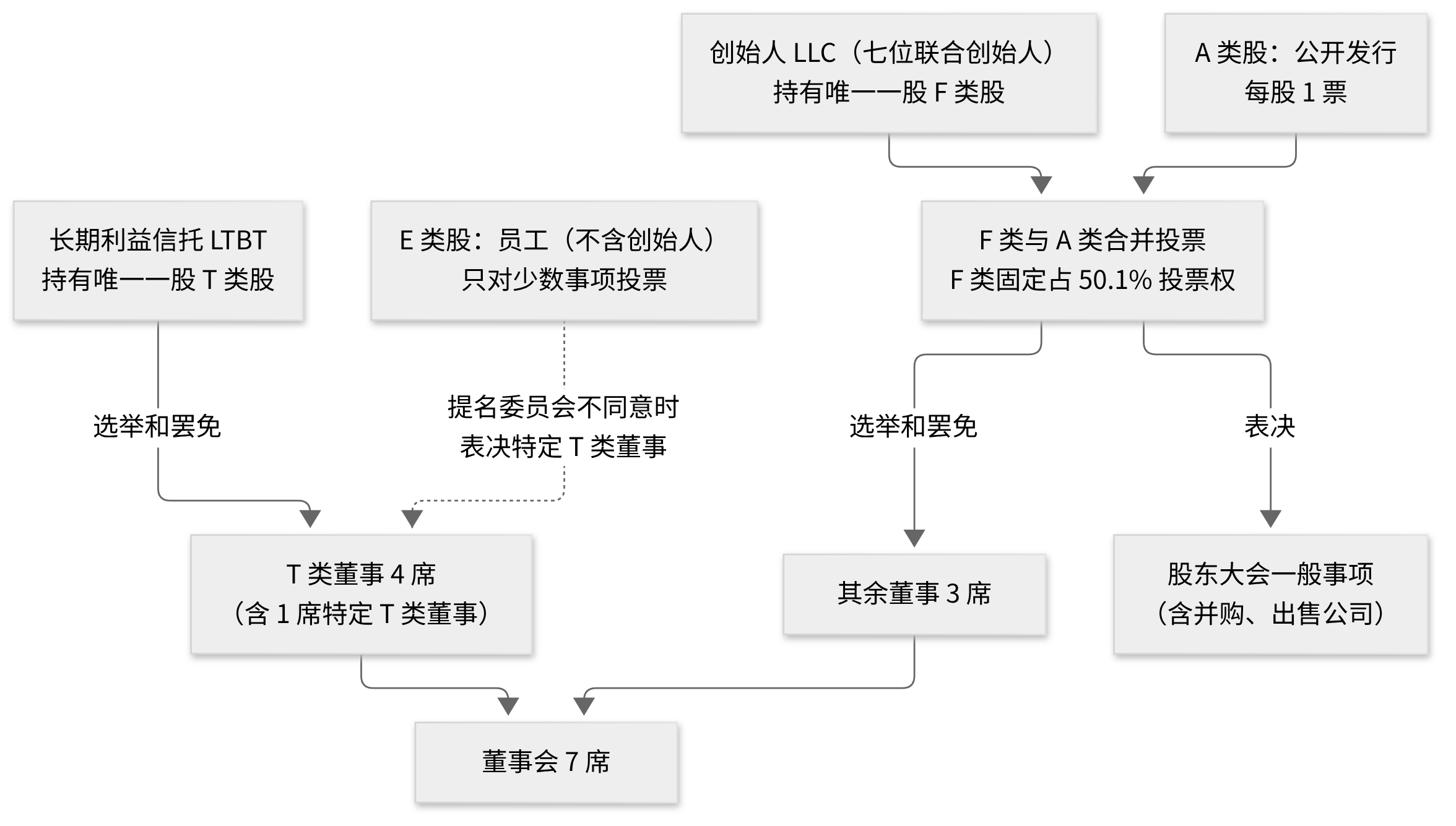
The chart above is based on the S-1’s description of the ownership structure: on the left, the LTBT elects 4 Class T directors, and Class E stock votes on that one Specified Director seat only when the nominating committee withholds consent; on the right, Class F and Class A vote together to elect the remaining 3 seats and also decide general stockholder matters.
What Controlled Company Status Means
Under Nasdaq rules, a company in which a single stockholder or group can elect a majority of the board is a controlled company and may be exempt from certain governance requirements, such as having a majority-independent board and fully independent compensation and nominating committees. The S-1 says Anthropic is a controlled company because the LTBT can elect a board majority, but it only intends to use one of these exemptions: its Nominating and Corporate Governance Committee will not be fully independent. The board currently has a majority of independent directors, and the audit and compensation committees are fully independent.
The risk factors state that for the foreseeable future, the LTBT and the founders’ LLC together can elect the entire board, and Class A stockholders generally won’t be able to change voting outcomes; hostile takeovers and proxy contests will also be harder.
In addition, the company has contributed 5% of its fully diluted capital stock, in the form of Class N shares, to a wholly owned subsidiary, Anthropic Public Benefit Fund, and each of the seven founders has pledged 80% of their personal equity to charity.
The Virtual Collaborator Positioning and Claude Code
What “Virtual Collaborator” Means
Both the summary and business sections of the S-1 contain a passage on “Claude as a virtual collaborator.” It opens with a claim: AI has reached an inflection point where it can be a genuine collaborator in professional work, quickly completing substantive tasks that would take a skilled professional hours, a full day, or longer. It then defines a virtual collaborator: an AI system that works alongside people to complete complex, multi-step work at a professional level. They come with the access, system connections, and context granted by the organization, can use internal tools and execute multi-step processes requiring sustained reasoning, and are designed to be embedded where the work happens.
The S-1 says the goal is to keep extending virtual collaborators to knowledge workers worldwide, and estimates this population will exceed 1 billion by 2028 (the footnote cites a developer population forecast from market research firm IDC). Further out, the S-1 envisions Claude taking on open-ended tasks lasting hours, days, or even weeks and completing them autonomously, eventually with millions of virtual collaborators working in parallel, which is what it calls “a country of geniuses in a datacenter.”
The S-1 also uses the word agent as usual: Claude Code is called “our coding agent,” Cowork is a “knowledge work agent,” and the risk factors discuss at length the risks and legal liability of agents acting autonomously.
How the Prospectus Presents Claude Code
In the S-1’s words, “the clearest expression of virtual collaborators today is Claude Code,” and the company considers it the product that “most concretely defines what autonomous AI work looks like.” The reasons given are sustained reasoning, a harness that turns intent into action, an execution environment that maintains state, tool integrations, and the interface. The example: NASA engineers used it to plan and write navigation commands for the Perseverance rover, which the S-1 calls the first AI-planned drive on Mars.
In the product descriptions, Claude Cowork is described as built on Claude Code’s agent architecture and aimed at a broader range of knowledge workers; the Agent SDK provides the same harness that powers Claude Code. The S-1 also says Cowork (research preview in January 2026) has been adopted faster than Claude Code (research preview in February 2025) was at the same point in time.
Numbers Related to Claude Code
There’s no separate revenue, user count, or annualized revenue. Two sets of numbers are directly tied to it.
One is in the customer expansion section: in Q3 2026, Claude Enterprise users who don’t use Claude Code spent less than $75 per month on average; the top 5% of spenders among Claude Code users spent about 20 times that. Note that this compares an average on one side with the top 5% on the other.
The other is about internal use: the S-1 uses the deployment of Claude Code across its engineering teams as an example of “using the current generation of models to build the next.” By internal benchmarks, Claude’s success rate on open-ended engineering problems with unclear requirements was about 90% in September 2026; in Q3 2026, code committed per engineer per day was more than 45 times the 2024 level; and in September 2026, more than 90% of contributions to the codebase were written by Claude.
Risks Related to Claude Code
Beyond the cyberattack above, the risk factors raise two more points: the company’s internal development relies heavily on Claude Code, so product errors or regressions would directly affect development of the next generation of models; and code generated with Claude Code may bring in open-source code, potentially subjecting the company to open-source license obligations without its knowledge, such as being required to release its own source code.
What to Watch After the IPO
- The offering price and Q3 revenue. Neither has been disclosed yet; Q3 revenue will show whether Q2’s growth pace has continued.
- The margin trajectory. How much of Q2’s 8% operating margin holds up depends on the pace of compute deliveries in the coming quarters.
- Stock-based compensation in the IPO quarter. The cumulative expense for RSUs whose service period has been satisfied (about $2.9 billion as of June 30) will be recognized all at once at the IPO, which could significantly widen that quarter’s operating loss, though no cash is involved.
What’s Still Unclear
-
H1 2026 and quarterly data are unaudited; metrics such as net revenue retention, internal benchmark success rates, and code contribution share come from the company’s internal systems, and the S-1 says they have not been independently verified by a third party.
-
Revenue by product isn’t disclosed, so Claude Code’s commercial contribution can only be inferred indirectly from the user spend comparison.
Final Thoughts
Putting these pieces together, the most striking thing is the mismatch in time horizons. Revenue has more than doubled quarter over quarter in each of the last two quarters, yet compute contracts are signed for six or seven years, even ten, and the ownership structure is designed around the long-term judgment of the founders and the trust. Costs and control have both been arranged on a horizon of a decade or more, while the only evidence that revenue can keep up is a few quarters of data. Whether revenue can keep pace with these long-term contracts will depend on the quarterly reports after the IPO; public market stockholders are buying the company’s growth, while where the company goes will mainly be decided by the founders and the Long-Term Benefit Trust.